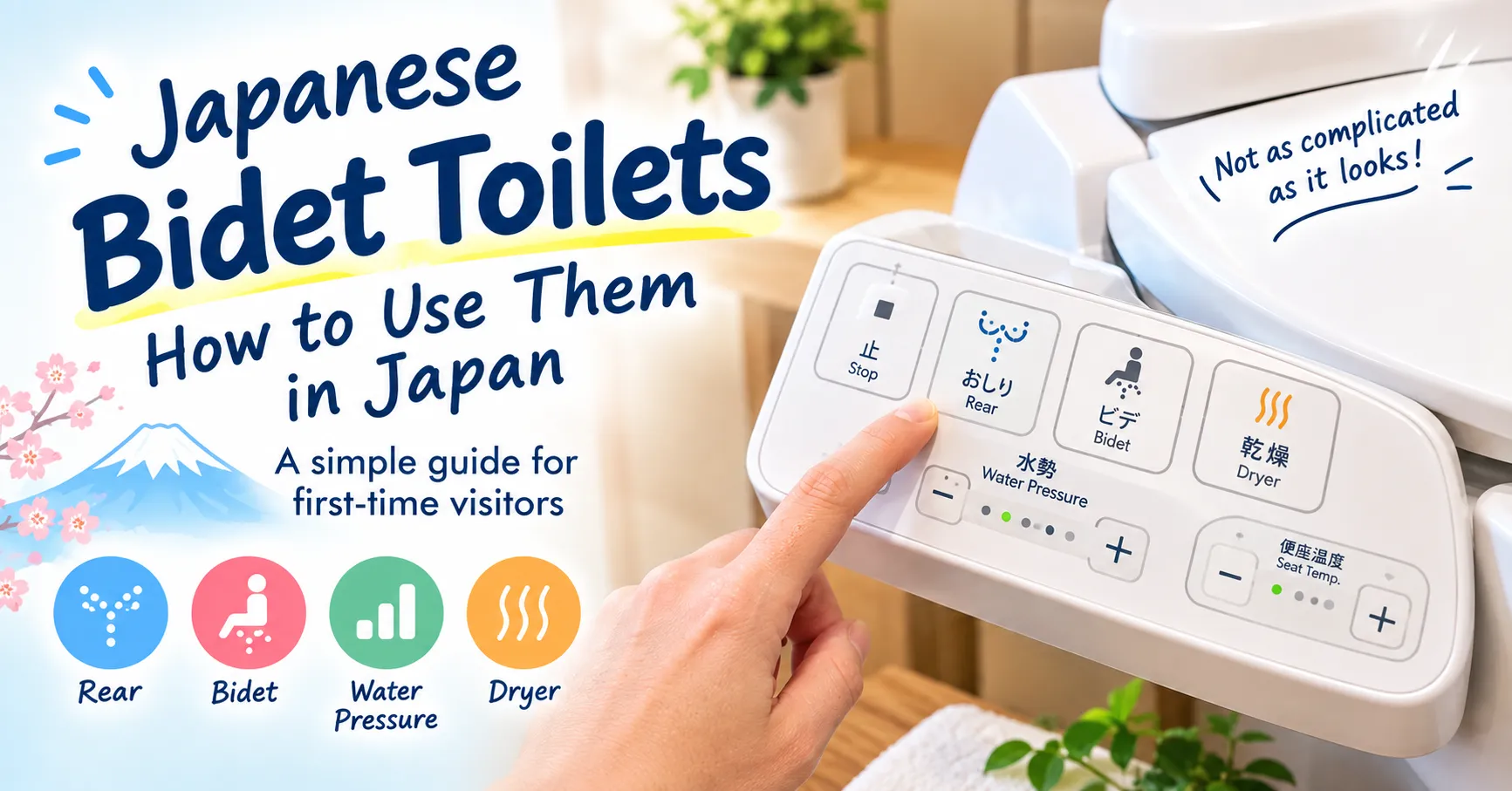
If you travel to Japan, you may notice something unusual about many Japanese toilets.
There may be a small control panel next to the toilet seat, with buttons for “Rear,” “Bidet,” “Water Pressure,” “Dryer,”and more.
If you have never used one before, you might wonder:
What do all these buttons do?
How am I supposed to use this toilet?
For people living in Japan, a toilet with a bidet function is not particularly unusual. But for first-time visitors, it can be a completely new experience.
And here is something about me that may surprise you.
I didn’t start using a bidet toilet until after I got married.
You might think that every Japanese person has been using one since childhood, but that isn’t necessarily the case.
For me, it became part of everyday life after I got married. At first, it was simply something new to get used to. Now, I hardly think about it.
That’s one of the interesting things about living in Japan. Something that seems unusual to visitors can be completely ordinary to people who live here.
So, if you are visiting Japan and see a toilet with lots of buttons, don’t worry. It looks more complicated than it really is.
In this guide, I’ll explain the basics of Japanese bidet toilets and how to use the most common functions.
What Is a Japanese Bidet Toilet?
A Japanese bidet toilet is a toilet or toilet seat with a built-in water spray for cleaning after using the toilet.
In Japan, you will often hear the word “Washlet” used to describe this type of toilet.
However, Washlet is a trademarked product name used by TOTO, one of Japan’s major toilet manufacturers. Not every bidet toilet in Japan is a TOTO Washlet.
For this reason, I will mainly use terms such as Japanese bidet toilet or bidet toilet seat in this article.
The basic idea is simple: instead of using toilet paper alone, you can use a gentle stream of warm water to clean yourself.
Some models have only a few buttons, while others look like they belong on a small home appliance.
Why Are Japanese Bidet Toilets So Common?
Bidet toilet seats are a familiar part of everyday life in Japan.
Depending on the model, a Japanese toilet may have features such as:
- Rear washing
- Bidet washing
- Heated toilet seat
- Adjustable water pressure
- Adjustable water temperature
- Deodorizing function
- Warm-air dryer
- Automatic flushing
- Automatic opening and closing of the lid
Of course, not every toilet has all of these features.
Some toilets are very simple, while others have a surprisingly large number of buttons.
When you live in Japan, you gradually stop thinking about these features.
For example, a heated toilet seat is especially nice during winter, but after using one for years, it just feels normal.
For visitors from overseas, however, these features can be one of the more memorable parts of traveling in Japan.
What Does the “Rear” Button Do?
One of the most important buttons to understand is the one marked “おしり” (oshiri).
“Oshiri” means buttocks or bottom, and on a Japanese toilet it means rear washing.
Pressing the button activates a water nozzle that sprays warm water to clean you after using the toilet.
The first time you see the nozzle move into position, you might be a little surprised.
Don’t worry. That’s what it is supposed to do.
Start With Low Water Pressure
If you have never used a Japanese bidet toilet before, I strongly recommend starting with low water pressure.
Some toilets can produce a surprisingly strong stream of water.
You can always increase the pressure if necessary, but starting gently is a much better idea.
Once you are finished, press the “止” (Stop) button.
Find the “Stop” Button First
If there is one piece of advice I would give to someone using a Japanese bidet toilet for the first time, it would be this:
Find the Stop button before you start.
Japanese toilet control panels can look complicated, especially when you cannot read Japanese.
But you don’t need to understand every button.
Just remember:
おしり (Oshiri) → Rear washing
ビデ (Bide) → Bidet washing
水勢 (Suisei) → Water pressure
止 (Stop) → Stop the washing
Personally, I think knowing where the Stop button is is more important than knowing where every other button is.
The important thing is not just knowing how to start the wash.
You should also know how to stop it.
What Does “Bidet” Mean?
You may also see a button marked “ビデ” (Bidet).
This is a separate washing function, generally designed for female users.
The position and direction of the water spray are different from the rear-washing function.
The exact operation can vary depending on the toilet model, so it is best to check the labels before pressing anything.
And don’t feel that you need to try every button just because they are there.
Start with the function you actually want to use.
Adjusting the Water Pressure
Many Japanese bidet toilets allow you to adjust the water pressure.
You may see buttons marked:
- Weak
- Strong
- Water Pressure
- + / −
The exact design depends on the model.
If this is your first time, start with the lowest or a relatively low setting.
If it feels too weak, gradually increase the pressure until you find a comfortable setting.
It may take a little experimenting to find what works for you.
Heated Toilet Seats
A heated toilet seat is another feature you may encounter in Japan.
This can be especially welcome during the colder months.
Imagine walking into a bathroom on a cold winter morning and sitting down on a warm toilet seat.
If you live in Japan, you might not think much about it anymore.
But if you are visiting from a country where heated toilet seats are uncommon, it can be a nice little surprise.
However, remember that not every toilet seat in Japan is heated.
If you sit down expecting a warm seat and find that it is cold, there is nothing wrong with the toilet. It simply may not have a heating function.
What Is the Dryer Button?
Some high-function toilets also have a “Dryer” function.
After washing with warm water, the toilet blows warm air to help dry the area.
It sounds very convenient, and it is.
However, drying can take a little time.
If you are in a hurry, using toilet paper may simply be faster.
This is something I like about Japanese toilets: they can offer many functions, but you don’t have to use all of them.
Start with the basics and use the features you find useful.
Where Can You Find Japanese Bidet Toilets?
You can find bidet toilets in many places around Japan, including:
- Hotels
- Train stations
- Department stores
- Shopping malls
- Airports
- Restaurants
- Tourist attractions
However, you won’t find them everywhere.
Older buildings and small restaurants may still have simple toilets without many additional functions.
In newer hotels and large commercial facilities, you are more likely to find toilets with a wider range of features.
You may also find control panels mounted on the wall rather than next to the toilet seat.
So, if you don’t see a control panel beside the seat, don’t immediately assume that the toilet doesn’t have a washing function.
What Should You Remember as a First-Time User?
You don’t need to memorize every Japanese word on the control panel.
These four are a good place to start:
| Japanese | Meaning |
|---|---|
| おしり | Rear washing |
| ビデ | Bidet washing |
| 水勢 | Water pressure |
| 止 | Stop |
And there is one more important point.
Use the controls while sitting on the toilet.
Some toilets have a sensor that detects whether someone is sitting on the seat. The washing function may not operate unless the sensor is activated.
The design and functions vary between manufacturers and models, so don’t worry if the controls on one toilet look different from another.
A Normal Toilet for Me, but a New Experience for Visitors
Japanese bidet toilets are sometimes introduced as an example of Japan’s advanced toilet technology.
They certainly can be impressive.
But for someone living in Japan, they are simply part of everyday life.
In my case, I didn’t even start using one until after I got married.
Before that, I didn’t particularly feel that I needed one.
After getting used to it, though, it became something I appreciated.
That’s probably true of many things in everyday Japanese life.
Something can feel unnecessary until you start using it regularly. Then one day, you wonder how you managed without it.
For international visitors, a Japanese toilet with a control panel full of buttons may look intimidating.
But once you understand a few basic buttons, it becomes much easier.
If you see one during your trip, look for “おしり”, “水勢”, and “止”.
Start with low water pressure, and you should be fine.
Final Thoughts
Japanese bidet toilets may look complicated at first, but the basic idea is actually quite simple.
Warm water is used to clean you, and many models allow you to adjust the water pressure, temperature, and other settings.
You don’t need to use every function.
Just find the buttons you need, start with a gentle water pressure, and remember where the Stop button is.
As for me, I didn’t start using a bidet toilet until after I got married. Now, it feels completely normal.
That’s perhaps what makes it interesting.
For Japanese people, it can be an ordinary part of daily life. For visitors, it can be one of those small things that makes a trip to Japan feel a little different.
And who knows?
After using a Japanese bidet toilet during your trip, you might return home and think:
“I want one of these at home.”
I wouldn’t be surprised.
